Reading a Quarry Face: Geology for Photographers Who Never Studied Rocks
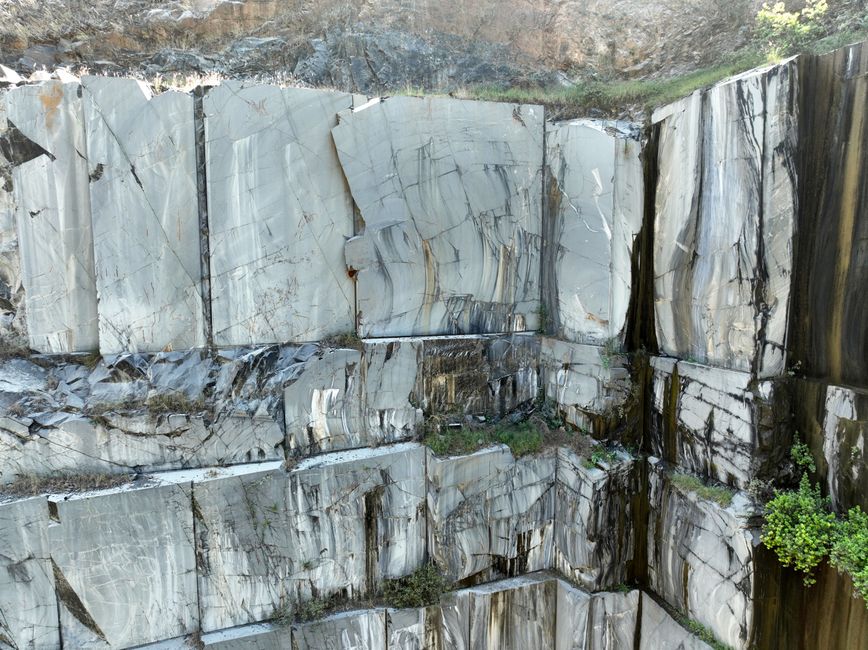
Most photographers arrive at a quarry and see a wall of rock. That is fine as a starting point, but the images get better once you understand what the wall is telling you. A worked face is a record of decisions — where the miners chose to cut, how the rock split, which seams were worth following and which were left behind. Learning to read that record takes an afternoon, not a geology degree.
Start with the obvious. Is the rock layered? Sedimentary stone like limestone and sandstone splits along bedding planes, which usually run roughly horizontal. You will see these as long parallel lines across the face, often picked out by water staining or vegetation. Igneous rock like granite has no bedding. Instead it fractures along joints, which tend to be more vertical and irregular. Metamorphic rock like slate sits somewhere between, with a strong cleavage direction that the quarrymen exploited by splitting blocks along it.
This matters for composition because the dominant line direction of the face will fight or support the lines in your frame. A horizontal-bedded limestone face photographed with the camera level produces a calm, stacked image. Tilt the camera and the same face becomes restless and unstable. Neither is wrong, but you should choose deliberately.
Using Scale and Texture
Quarry faces are almost always bigger than they look in photographs. A hundred-metre wall can read as a garden rockery if there is nothing in the frame to give it scale. A person is the obvious answer, but a ladder, a rusted ladder rung, a solitary birch tree growing from a ledge, or a piece of abandoned machinery will do the same job without putting a human in the shot.
Texture is the other thing that separates a good quarry photograph from a bad one. Weathered rock has remarkable surface detail — drill marks, blast fractures, tool scars, mineral staining. To capture that, you need light that grazes the surface at a low angle. Midday sun flattens everything. Early morning and late afternoon are when the face comes alive, and the difference between the two is often just which way the wall faces.
Colour, Mineral, and Mood
Rock colour varies enormously and is worth paying attention to. Slate can run from near-black through purple and green. Granite is often grey but can be pink or almost white. Limestone tends toward pale yellows and greys, and iron deposits stain faces with orange and rust red. These colours will interact with whatever light you have, and knowing them in advance helps you decide whether to shoot in colour or convert to black and white later.
Black and white often suits quarry photography because it strips away distracting colour and emphasises form and texture. But do not default to it. A slate face in low evening sun, with heather growing from the spoil, is a colour photograph waiting to be made.